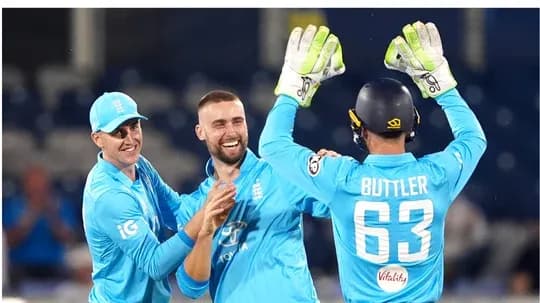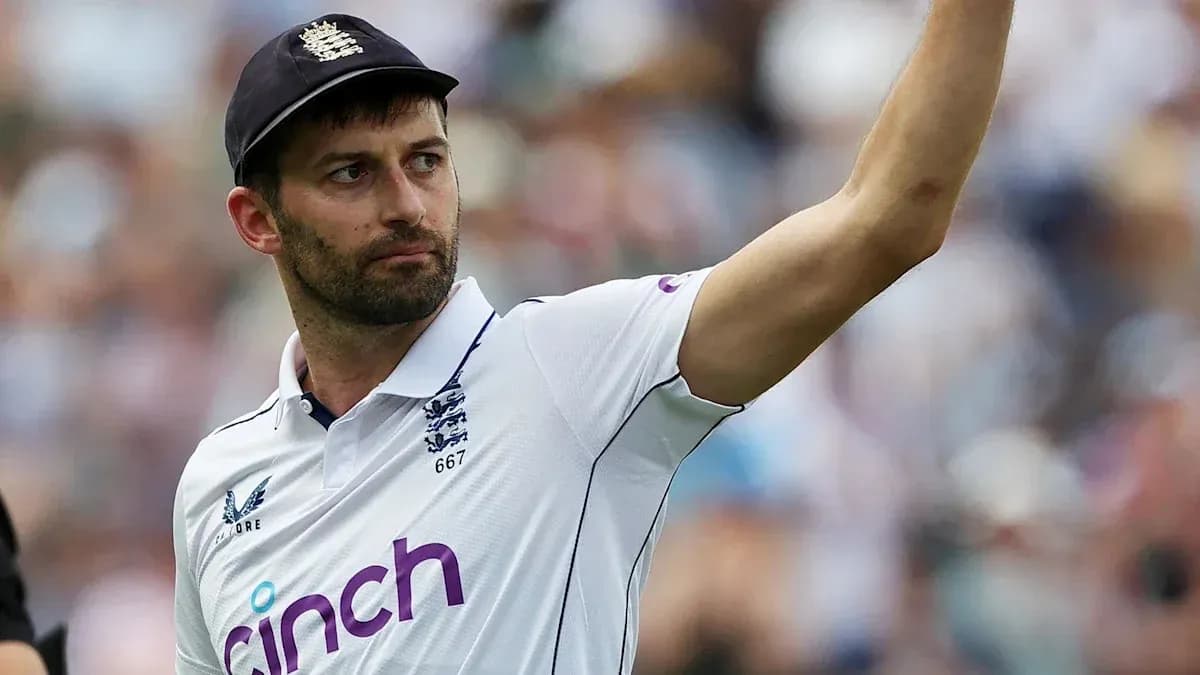
Mark Wood, England’s thunderbolt quick, has called time on his international career – and with him goes one of the most exhilarating sights modern cricket has known.
The 36-year-old Durham fast bowler, among the quickest ever to pull on an England shirt, announced his retirement with immediate effect after a brutal final year in which his body finally refused to follow his will.
He had only just fought his way back. Fifteen months out after elbow trouble and knee surgery, then a return in the first Ashes Test in Perth last November. Eleven overs. That was all. The left knee swelled again, the pain returned, and Wood was on a plane home. He never bowled for England again.
On social media, he admitted the inevitable had arrived.
“It just feels like a natural time at the end of my contract,” he said, laying bare the reality of a career spent wrestling with injury. “I’ve always tried to be resilient and come back from injury to prove people wrong and show everyone what I can do. Unfortunately, this time I lost the battle.”
Doctors told him Test and 50-over cricket were no longer possible. The dream, as he put it, had been “slowly ground out” of him over the past year. The England cap, though, never lost its shine.
“Playing for England has been the greatest honour I could have ever wished for and a dream come true,” he wrote, adding that he still hopes to play the game in some capacity.
A career of speed, scars and silverware
Wood’s numbers only tell part of the story, but they are strong enough on their own. He took 119 wickets in 38 Tests after his debut in 2015, the summer he helped England win back the Ashes on home soil. In white-ball cricket, he finished with 80 wickets in 70 ODIs and 54 in 38 T20 internationals, leaving as England’s sixth-highest wicket-taker in men’s T20s.
The cost was written across his body. Ankles. Knees. Elbow. The list of injuries reads like a medical chart for a fast bowler pushing himself to the absolute limit.
In 2018 he tried to outsmart the pain. He lengthened his run-up to ease the strain on his body. It worked, to a point. The pace stayed. The impact grew.
The reward came on the biggest stage. Wood played a central role in the 2019 World Cup triumph, taking 18 wickets as England lifted the trophy on that surreal day at Lord’s. He batted that afternoon too, limping out to join Ben Stokes despite carrying an injury, another small act that underlined how far he was willing to push himself for the shirt.
He was also part of the squad that won the T20 World Cup in 2022, although a calf problem denied him the closing chapters of that campaign.
Rob Key, England’s managing director of men’s cricket, paid a pointed tribute to a bowler who changed matches and moods.
“It’s been a privilege to watch the latter part of a great career,” Key said. “To have been a point of difference in Ashes series wins, two World Cup wins, and to have thrilled crowds every time he got the ball in his hand is something very few players achieve. He can look back with enormous pride on a career very well spent.”
The thrill of Wood at full tilt
Anyone who has ever picked up a cricket ball has tried, at least once, to bowl fast. Wood lived the fantasy at full volume.
At his best he didn’t just bowl quickly; he seemed to hurl himself through the crease, often ending in a heap on the turf as the ball thudded into the keeper’s gloves. That image – Wood flying in, giving everything to every delivery – became one of the most gripping sights in the sport.
He captured crowds with more than pace. There was the grin, the self-deprecating humour, the obvious joy in the contest. He never looked like a man burdened by the game, even as it took so much from him. He joked with fans, embraced the theatre, and always gave the impression he knew cricket was meant to be fun.
The “what if” will always linger. What might he have been with a more forgiving body? How many more spells like his finest could he have produced? Fast bowling is an unnatural act, and the job punished Wood harder than most.
When everything clicked, though, it was devastating.
St Lucia in 2019 stands out. Fresh run-up, same ferocious speed, West Indies dismantled. It was a glimpse of the second act his remodelled action promised.
He was one of the few England players to emerge with credit from the grim Ashes tour of 2021-22, his pace cutting through the gloom. Then came 2023 and a Headingley performance that will live in Ashes folklore.
Held back until the third Test with England 2-0 down, Wood arrived like a storm. He bowled at extreme pace, topped by a 95mph thunderbolt that uprooted Usman Khawaja. That spell turned the match and, with it, the series. Later, in a tense run chase, he was there again – this time with the bat – alongside his close friend Chris Woakes, steering England over the line.
Without those two, brought in late and unleashed together, that summer could have been a rout. Instead, England dragged the series back to 2-2, and Wood’s surging spells were central to the comeback.
The last of a rare club
Wood’s CV sits in rare company. He is among the select group of England players to have won both World Cups and the Ashes. He was part of the last England side to regain the urn in 2015, a series that now feels a long way removed from the current landscape.
With his retirement, Joe Root stands alone as the only active England Test cricketer to have experienced Ashes glory.
There was no final flourish in Australia for Wood. The long rehabilitation from elbow and knee injuries did not restore the pace England craved on the 2023-24 tour. He played only the first Test in Perth and later admitted he felt “ashamed” of what unfolded there. The honesty was typical. So was the sense that he had wanted to give more.
His exit underlines a wider shift. Stuart Broad has gone. James Anderson has stepped away. Chris Woakes has followed. Now Mark Wood joins them. Add in the all-round heft of Ben Stokes’ bowling being severely curtailed, and England have lost 1,871 Test wickets in under three years.
The numbers tell you what has disappeared. The memories of Wood at full sprint, hair streaming, body contorting, ball fizzing past the bat, tell you what can’t be replaced.