At 10pm in Albert Park, the game is over but the lights are only just getting started.
On Queens Rd, John is walking the streets, not for exercise or fresh air, but because he can’t bear to be inside his own apartment. The glare from Junction Oval’s new LED towers punches straight through his windows, bounces off every surface and turns his supposed sanctuary into a floodlit stage.
“Bright as hell,” he calls them. He’s not exaggerating.
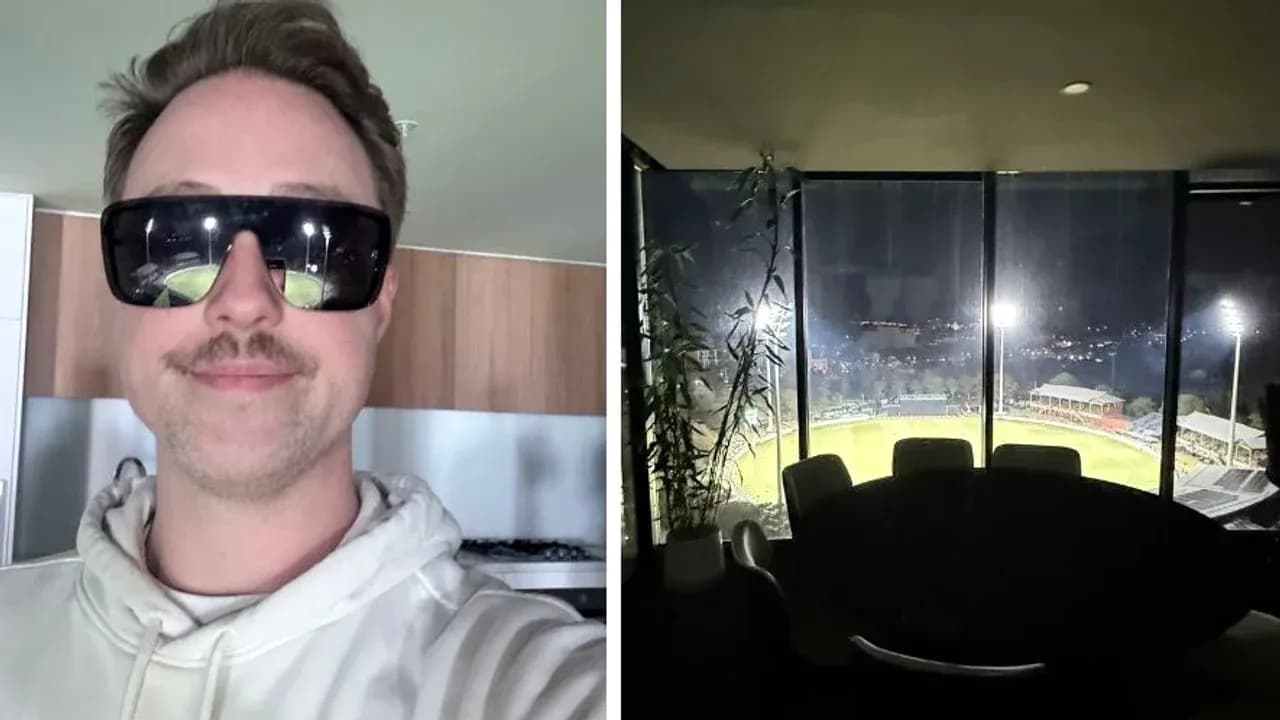
Seventeen floors up, Andrew has resorted to sunglasses in his own living room. Photos from his apartment look like dawn is breaking over Albert Park. It isn’t. It’s night cricket.
His place, he says, “lights up like a Christmas tree”. Blockout blinds? Useless. The beams slice straight past them and ricochet around the glass and polished surfaces.
Three floors down, James doesn’t need a scorecard to know when something big happens out in the middle. The strobing that accompanies celebrations sneaks through the cracks of his blinds, throws a makeshift disco around his bedroom, then settles back into a relentless white glare.
This is life now for residents around Cricket Victoria’s Junction Oval: at least two nights a week of artificial daylight, and on some stretches, up to four.
A ground reborn, a neighbourhood redefined
The trouble began in August, when Cricket Victoria finished installing four 50-metre light towers, a multimillion-dollar upgrade sold as essential for broadcasting women’s cricket.
On paper, the rules sound strict enough. No use after 11pm for broadcast or streamed events. A 10pm cut-off for other fixtures. A 30-minute grace period for patrons and staff to leave, with lighting capped at 10 lux. A hard limit of 45 nights a year.
On the ground – and in the towers opposite – it feels very different.
Residents say the lights have already been used for testing, matches and training on almost half that annual quota in just a few months. They’ve watched the oval bathed in full power when no one appears to be on the field. They’ve seen night training lit by the big towers even though, they say, other “less invasive lights” sit idle.
Locals saw this coming. As soon as the project was floated, a change.org petition sprang up, warning of exactly this scenario. More than 500 people signed. It didn’t matter. The state pushed ahead, the towers went up, and the battle between a boutique inner-city neighbourhood and a high-performance sports facility was on.
‘We’re effectively living in a box’
James bought his apartment 12 years ago for one reason: the view over Albert Park. The lake. The trees. The oval, sure, but as part of a wider picture.
Now, when the lights go on, the view disappears.
“They turn the lights on even though it’s daylight savings,” he said. “They turn them on about 6pm and the amount of light that comes through the apartment, even with the blinds drawn. We’re effectively living in a box.”
Inside that box, the light finds fresh surfaces to attack. Glass splashbacks. Internal glass walls. Reflections on reflections, bouncing around the apartment.
“Then there’s the strobing lights when they catch a ball or something … we’ve got glass inside our apartment as well so it reflects off the splashback, the internal glass walls, it’s terrible.”
The family has started eating dinner at opposite ends of the table, angling themselves away from the harshest glare.
For John, this isn’t just an irritation. It’s physical.
He has a degenerative cornea and hyperthyroidism, both of which heighten his sensitivity to light. The towers turn his home into a health hazard.
“I end up getting really bad migraines and headaches,” he said. “So if I’m in my apartment which is your home, your safe place where you feel secure, it just feels very violating having these lights on.”
So he leaves. On game nights, he simply disappears until after 11pm.
“I literally do not want to be at home when the lights are on and I’ll get home at 11pm purely because the lights reflect off my TV into my bedroom … and I have zero interest in being at home when the lights are on.”
Even the drive home is an ordeal.
“Even driving home along Queens Rd, as I’m pulling into the building, I need to have sun visors down in the car because (the lights) are blinding.”
He worries about others too. The pyrotechnics and strobing, he says, are a genuine risk for anyone with photosensitive epilepsy in nearby buildings or the homeless encampment near the oval.
“Anyone with photosensitive epilepsy could have an episode… Who’s actually evaluated that risk? Or who’s taking that into consideration?”
Andrew didn’t wait to find out. He and his partner moved out.
“Other people don’t have that opportunity,” he said.
He still owns the apartment and rents it out, but every time he returns, the feeling is the same.
“I think it’s ruined the beauty of the area, even when I go back there now I just look at it and I’m taken away from the view and beauty of it all,” he said.
“But the lights, oh my god, it’s like living next to the MCG. I remember them going in and feeling so violated that we had no control over the four 50-metre-high lights being built right in front of our home.”
The audit that says nothing’s wrong
On the residents’ side of Queens Rd, there are migraines, moved dinners, people forced out of their homes for the night. On paper, none of it exists.
An independent engineering audit, quietly submitted to the state government, declared the 50-metre towers “generally compliant” with Australian standards and recommended “no remedial measures”.
“No material exceedances attributable to the Junction Oval lighting installation were identified, and no remedial measures are considered necessary based on the assessment undertaken,” the Lucid Consulting report found.
It did note two spots on Lakeside Drive where light levels exceeded the 25 lux limit. But it pinned that on existing streetlights and “mild humidity” scattering light in the night air, then dismissed the issue.
For residents, that conclusion felt like a punchline.
They point out the report “made no mention of Queens Rd”, where the bulk of high-rise apartments face the oval. They say testing was done at ground level, not at the 10th, 15th or 17th floors where the light slams straight through their windows.
“The report makes no mention of Queens Rd, no mention of the apartment buildings within 50 to 200 metres of the towers and no mention of any measurement of line-of-sight intrusion into surrounding apartments,” James said.
At least eight official complaints have been lodged with Cricket Victoria, Port Phillip Council and Parks Victoria. Residents say the response has been silence, or polite deflection at best.
‘A bit of a farce’
The anger isn’t just about the lights. It’s about how the project was pushed through.
Residents say community consultation was rushed and tokenistic. Notices for a key session with Cricket Victoria, they claim, were dropped into letterboxes on the day of the meeting.
“There was no concern of what the broader community wanted,” John said.
“When we had a session with Cricket Victoria, a notice was sent (informing residents about it on) the day of the meeting … they were all hand delivered or put in our letter boxes on the day of the meeting so there were some very shady mannerisms.”
Inside the meeting, it didn’t get better.
“The question I asked at the meeting was how comfortable would you feel having a street light flash into your bedroom window,” John said.
“And they kept beating around the bush not giving a straight answer and I literally told them it’s a yes or no answer … we never got anywhere.
“We had that one consultation session where we said the lights need to be reduced in height and there was no sort of consultation that happened after it. It was sort of like, ‘this is what we’re doing. Either accept it or there’s nothing you can do about it’.”
Cricket Victoria tells a different story. A spokeswoman said consultation began in March and April 2025, with direct mail notification to neighbouring residents and an open forum at Junction Oval.
“Community members were also invited to sign up to a mailing list – Friends of Junction Oval – to receive relevant project updates,” she said.
Two versions of the same process. One side calls it a box-ticking exercise. The other calls it engagement.
Everyone’s in charge. No one is responsible.
Legally, Cricket Victoria is in the clear. The towers were approved via a special ministerial planning amendment that bypassed local council. The curfews and 45-day operational cap are written into that approval.
When residents ask who will enforce those conditions, the answers start to blur.
Port Phillip Council says it has no power here. The land is Crown land, managed by Parks Victoria, and the state government signed off on the lights.
“While Council has no regulatory role, we have engaged in discussions with Cricket Victoria to advocate on behalf of our community and seek practical solutions to address concerns raised,” City of Port Phillip chief Chris Carroll said.
Local MP Nina Taylor said her office received “a number of objections” to the light installation in early 2025.
“In every case, I forwarded the objection to Cricket Victoria and asked that their submission be registered as part of their community consultation process,” she said.
She did not address current complaints about the impact of the lights.
Parks Victoria, as land manager for Albert Park Reserve, declined to comment publicly. It is understood to hold regular meetings with Cricket Victoria, where residents’ issues can be raised. For residents, that’s another closed-door process they’re not part of.
Parks Victoria pointed questions to the Department of Transport and Planning. A spokesman there said the department had worked with Cricket Victoria and Port Phillip City Council “to support improved sporting infrastructure at Junction Oval”.
“Cricket Victoria has submitted an independent assessment of the lighting system, which we’re now reviewing,” he said.
Cricket Victoria, for its part, is emphasising the upside.
A spokeswoman said the organisation is working with businesses on Fitzroy Street “to ensure the economic opportunities from increased attendances can be realised”.
“Cricket Victoria remains committed to engaging constructively with our local community,” she said.
“The lights have been used for training on a small number of evenings which fall within the approved maximum of 45 nights of use per year.
“It is important for our male and female cricketers to be able to train under evening conditions like our competitors across the country.”
Cricket Victoria did not answer questions about what, if anything, it is doing specifically for residents at 83 Queens Rd.
A stadium glow that won’t go away
The clash here is obvious. Elite sport wants night games, TV-friendly schedules and training under match conditions. The neighbourhood wants darkness, or at least something close to it, after a certain hour.
In Albert Park, that tension is now etched across the skyline.
Four 50-metre towers loom over apartments that were sold on views of the lake and the city. The homeless encampment nearby, residents say, is also bathed in the same unrelenting glare, hitting some of the most vulnerable people in the area.
On one side, an audit says everything is “generally compliant”. On the other, people are timing their return home to avoid a light show they never signed up for.
For now, the towers stand, the fixtures continue, and the independent reports sit with government departments for review.
The residents aren’t done. They’re exploring what steps remain – legal, political, technical – to have the lights dimmed to something they can live with.
Because the cricket ends. The crowd goes home. The cameras switch off.
But for the people on Queens Rd, the night doesn’t really start until the last tower finally goes dark.