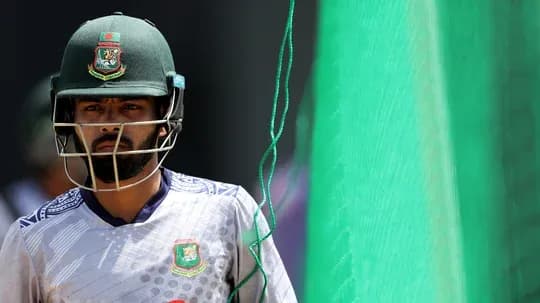
The last time Towhid Hridoy walked off Potchefstroom with a trophy in his hands, he was a teenager riding the high of an ICC Under-19 World Cup triumph in 2020.
He has just rewritten his story there.
An unbeaten 350 against South Africa A – the highest first-class score by a Bangladeshi batter – has dragged his name back into the red-ball conversation that once seemed to spit him out almost as quickly as it welcomed him in.
From late call-up to record-breaker
Hridoy was not even meant to be the headline act of this tour. He landed in South Africa as part of a hastily assembled Bangladesh A group, flown in alongside Nurul Hasan, Rishad Hossain and Mohammad Saifuddin after injuries and visa complications left the original squad threadbare.
He spoke at the airport in Dhaka like a man with his eyes fixed on something else. The four-day games? Useful, yes, but only as a stepping stone. He talked about conditions, white-ball cricket, the looming series against the Proteas, and the ODI World Cup that follows.
“The preparation is very important and as we have a national team tour and the World Cup (ODI), will try to prepare for it,” he told reporters before boarding.
Test cricket barely featured in his words. No grand declarations. No public lobbying. And with his past, it was easy to see why.
Burned once by the whites
Hridoy had waited more than three years to crack the Test side after breaking into Bangladesh’s white-ball teams. When the chance finally came, it vanished almost immediately. One Test. Three days of cricket. A failure in Harare against Zimbabwe, and he was gone.
The debates started quickly. Some said he had been rushed. Others picked apart his technique and stamped him as a white-ball specialist. Very few stood up and argued he should be persevered with in the longest format.
All this against the backdrop of a selection panel that often insists that once a player breaks into the national side in any format, he will get a fair run to prove himself. In Hridoy’s case, that principle never really materialised. One poor Test, and the door shut.
No wonder he stopped looking too far ahead when it came to red-ball dreams.
A triple hundred that cannot be ignored
Potchefstroom forced the conversation back.
By going past Tamim Iqbal’s unbeaten 334 and Raqibul Hasan’s unbeaten 313, Hridoy did more than just pile up runs. He joined an exclusive group as only the third Bangladeshi to hit a triple hundred in first-class cricket, and he did it with the kind of authority that leaves selectors with no place to hide.
And yet, even after a marathon 350*, his tone remained cautious.
“This is not entirely my call, as a professional player I always want to do well, I have said this on many occasions before, how many matches I will play for the national team will depend on the selectors, if I get the opportunity I will try to do well,” he said after the game, when asked about his red-ball ambitions.
No demands. Just a reminder that he has done his part.
The real test now lies with the selectors
Bangladesh’s next Test series will arrive with Hridoy’s name written in bold across every selection meeting agenda. On numbers alone, his innings against South Africa A is impossible to brush aside. On context, it is even louder.
The challenge for the selectors is no longer just whether they can squeeze him into a Test squad. It is whether they can convince him – and the dressing room – that this time, opportunity will not be as fragile as a single innings in Harare.
Because this 350 did not come from a man consumed by the fear of being dropped. It came from a batter who had almost detached himself from the red-ball narrative, freed up by the knowledge that his future, in his own mind at least, lay in white-ball cricket. That freedom let him bat, and bat, and bat again against South Africa A, showing a red-ball ceiling that many had doubted he possessed.
Now the question hangs over Bangladesh cricket, not over Hridoy.
They have seen what he can do when he is not looking over his shoulder. Are they ready to find out what he might become if he is finally given the time and trust that Test cricket demands?